




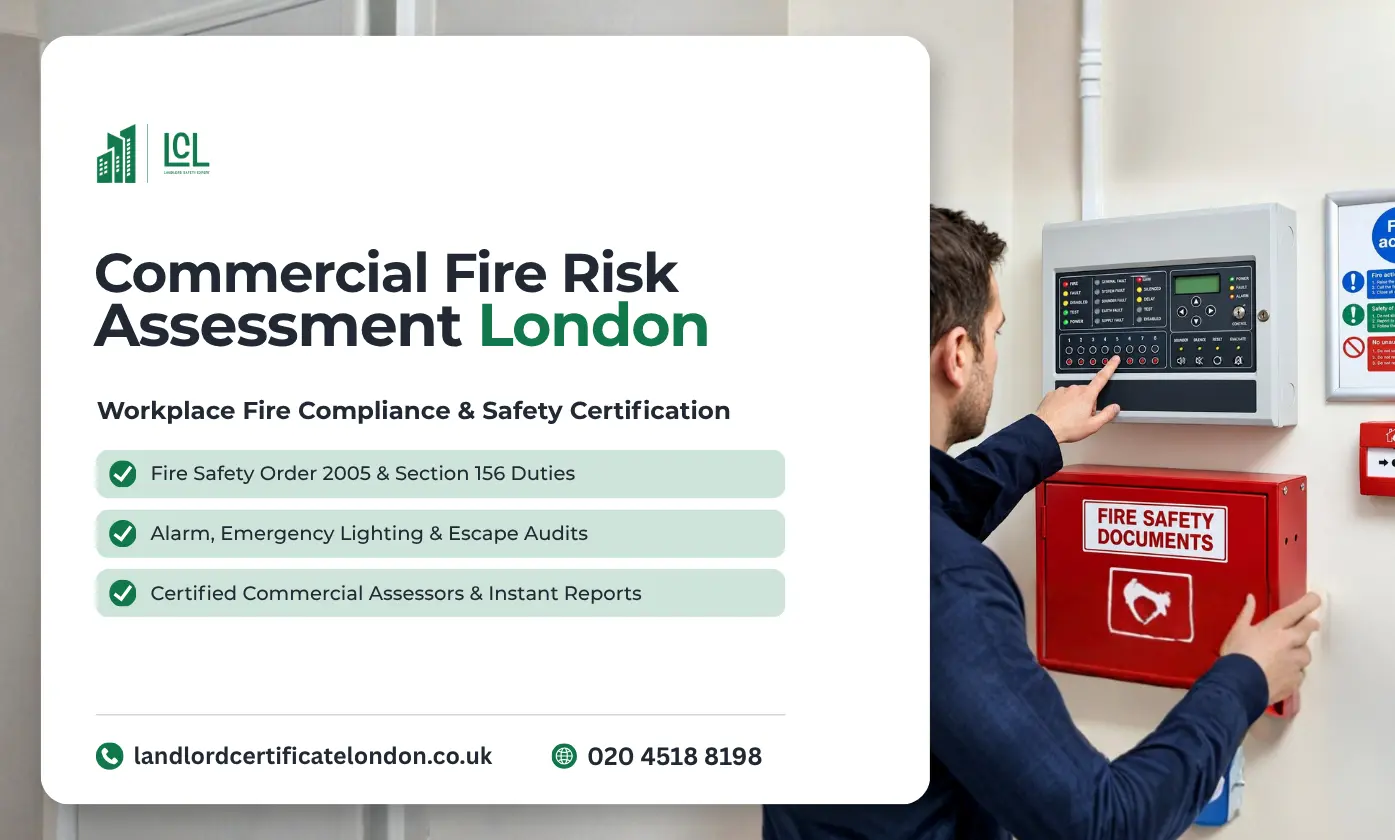
A commercial fire risk assessment in London helps you identify fire hazards, understand who may be at risk, and decide what safety measures your workplace needs. Under the Regulatory Reform (Fire Safety) Order 2005, you must assess fire risks, record the findings, and put suitable precautions in place. You should also review the assessment when changes to your premises or business activities could affect fire safety.
At Landlord Certificate London, we help business owners, landlords, and property managers arrange workplace fire risk assessments across London. Our services support your fire safety responsibilities and help you maintain clearer compliance documentation.

Field Insight from Hassan Sharif
Business Development Manager & Compliance Specialist at Landlord Certificate London
“When carrying out commercial fire risk assessments across Greater London—from multi-storey corporate offices in the City to converted warehouse studios in Shoreditch—the most alarming recurring defect we discover isn’t a lack of extinguishers; it is the widespread practice of wedging open self-closing FD30 and FD60 fire doors to improve air circulation or ease staff movement. During a recent audit of a three-storey tech firm near Old Street, we found fire doors on the central escape stairwell held open with wooden wedges on every single floor, while emergency exit routes were partially obstructed by flat-pack delivery cartons. Under Section 156 of the Building Safety Act, failing to record, maintain, and enforce compartmentation controls creates immediate legal liability for the Responsible Person. A commercial FRA is never just a tick-box document to store on an office shelf; it is an active life-safety audit designed to verify that physical fire separations, emergency lighting batteries, and audible alarms will function flawlessly when seconds count.”
What is a Commercial Fire Risk Assessment?
A commercial fire risk assessment is a review of your workplace to identify fire hazards, assess risks to people, and decide what precautions are needed. It also looks at existing fire safety arrangements, including escape routes and emergency procedures. The findings help the Responsible Person plan improvements and meet their legal duties.
Five Essential Steps of a Business Fire Risk Assessment
A professional assessment examines how fire could start, spread, and affect occupants. The UK government’s five-step framework provides a practical approach to identifying risks and implementing suitable controls. Your assessment should reflect your building’s actual layout, activities, occupancy, and emergency arrangements.
- ✓Identify fire hazards: Examine electrical installations, combustible storage, heating equipment, cooking facilities, and flammable substances.
- ✓Identify people at risk: Consider employees, customers, contractors, visitors, night workers, and people who may need evacuation assistance.
- ✓Evaluate and reduce risks: Review ignition sources, fire protection systems, escape routes, and existing preventive measures.
- ✓Record findings and prepare: Document significant risks, assign corrective actions, establish emergency procedures, and train employees.
- ✓Review and update: Reassess precautions when workplace conditions change or existing arrangements become unsuitable.
Why London Businesses Need Fire Risk Assessments
An office fire risk assessment in London can identify overloaded sockets, damaged fire doors, blocked staircases, and inadequate evacuation arrangements. Restaurants may face additional cooking-oil hazards, while warehouses may require special attention to combustible materials and storage practices. Each workplace needs precautions suited to its specific fire risks.
Who is the ‘Responsible Person’? Employer & Commercial Landlord Legal Duties
The Responsible Person is usually the employer or someone who controls the premises, such as a business owner, landlord or occupier. Under the Regulatory Reform (Fire Safety) Order 2005, they must assess fire risks, maintain suitable precautions, and provide appropriate fire safety information and training. In shared buildings, more than one party may have responsibilities.
Who Is the Responsible Person for Fire Safety?
The identity of the Responsible Person depends on who controls the workplace and its safety arrangements. An employer normally manages fire safety within its occupied premises, while a commercial landlord may control shared corridors, staircases, or communal systems. In multi-tenanted properties, several parties can hold overlapping responsibilities.
Essential Responsible Person Duties
Responsible Person duties include documented assessments, appropriate precautions, staff information, emergency plans, and coordination with other duty holders. Your arrangements should identify who checks safety equipment, organises drills, updates the fire safety log book, and completes outstanding actions. The following checklist turns these legal responsibilities into practical tasks.
- ✓Written assessment: Complete, record, and regularly review a suitable and sufficient fire risk assessment.
- ✓Safety equipment: Maintain necessary alarms, emergency lighting, extinguishers, and protective systems.
- ✓Employee training: Provide appropriate fire safety instruction and emergency procedure training.
- ✓Evacuation planning: Establish safe escape arrangements and conduct regular fire drills.
- ✓Documentation: Maintain appropriate inspection records, maintenance reports, and an up-to-date fire safety log book.
- ✓Coordination: Exchange relevant fire safety information with other Responsible Persons sharing the commercial building.
Is a Written Commercial Fire Risk Assessment a Legal Requirement in the UK?
Yes. Changes introduced through Section 156 of the Building Safety Act 2022 require Responsible Persons to record their fire risk assessments and safety arrangements in full, regardless of employee numbers. The previous five-employee threshold for recording assessment information no longer applies.
You must also record relevant assessor details when someone completes or reviews the assessment on your behalf. Failure to comply can lead to enforcement action, prosecution, and potentially unlimited fines. Certain serious offences under the Fire Safety Order can result in imprisonment of up to two years.
Key Fire Safety Pillars for London Workplaces: Detection, Emergency Lighting, Suppression & Escape
Effective commercial fire safety depends on four connected precautions: early detection, emergency escape lighting, suitable firefighting equipment, and safe evacuation routes. These systems must reflect the risks identified in your assessment and remain operational through inspections, maintenance, training, and documented emergency arrangements. Each supports a safe and timely evacuation.
Fire Detection and Alarm Systems
Commercial workplaces need suitable fire detection and warning arrangements so occupants receive enough notice to escape safely. BS 5839-1 provides recommendations for fire alarm systems in non-domestic buildings, including design, installation, commissioning, and maintenance. Your risk assessment determines the appropriate system category and detector coverage.
Inspect the following essential elements:
- ✓Manual call points and automatic smoke or heat detectors positioned along escape routes and hazard zones.
- ✓Audible alarms and suitable visual alarm warning beacons for high-noise areas.
- ✓Alarm control panel functionality, fault reporting indicators, and battery backup power.
- ✓Routine maintenance records, logbook entries, and competent periodic servicing.
Retain relevant commissioning and inspection evidence, including your commercial fire alarm certificate where applicable. If you require related inspection services, explore the company’s fire safety certificate service. An alarm inspection document supports your records but does not replace a comprehensive commercial fire risk assessment.
Emergency Lighting BS 5266 Requirements
Emergency lighting helps people find their way to safety when the normal mains lighting fails. BS 5266-1 provides recommendations for designing, inspecting, testing, and maintaining these systems. Depending on your building’s layout and fire risks, emergency lighting may be needed along corridors, stairways, changes in floor level, final exits, and external assembly routes. Regular checks help identify luminaire and battery faults before an emergency occurs.
Fire Suppression and Escape Routes
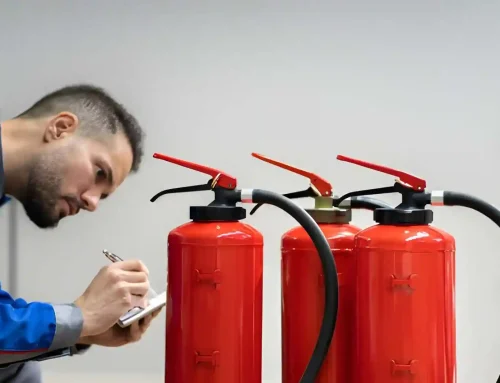
Fire extinguishers should match the hazards in your workplace rather than simply being placed wherever space is available. Your assessment should consider the types of fire that could occur, where equipment is needed, and whether staff require instruction in its use. Choosing the wrong extinguisher can make a dangerous situation worse. Clear escape routes and properly maintained fire doors are equally important for safe evacuation.
Escape routes must remain clear, adequately protected, and easy to identify. Fire doors should close correctly without sticking, and emergency exits must be usable without keys or unnecessary delay. Your evacuation plan should also account for disabled occupants, visitors, contractors, and employees working outside normal business hours.
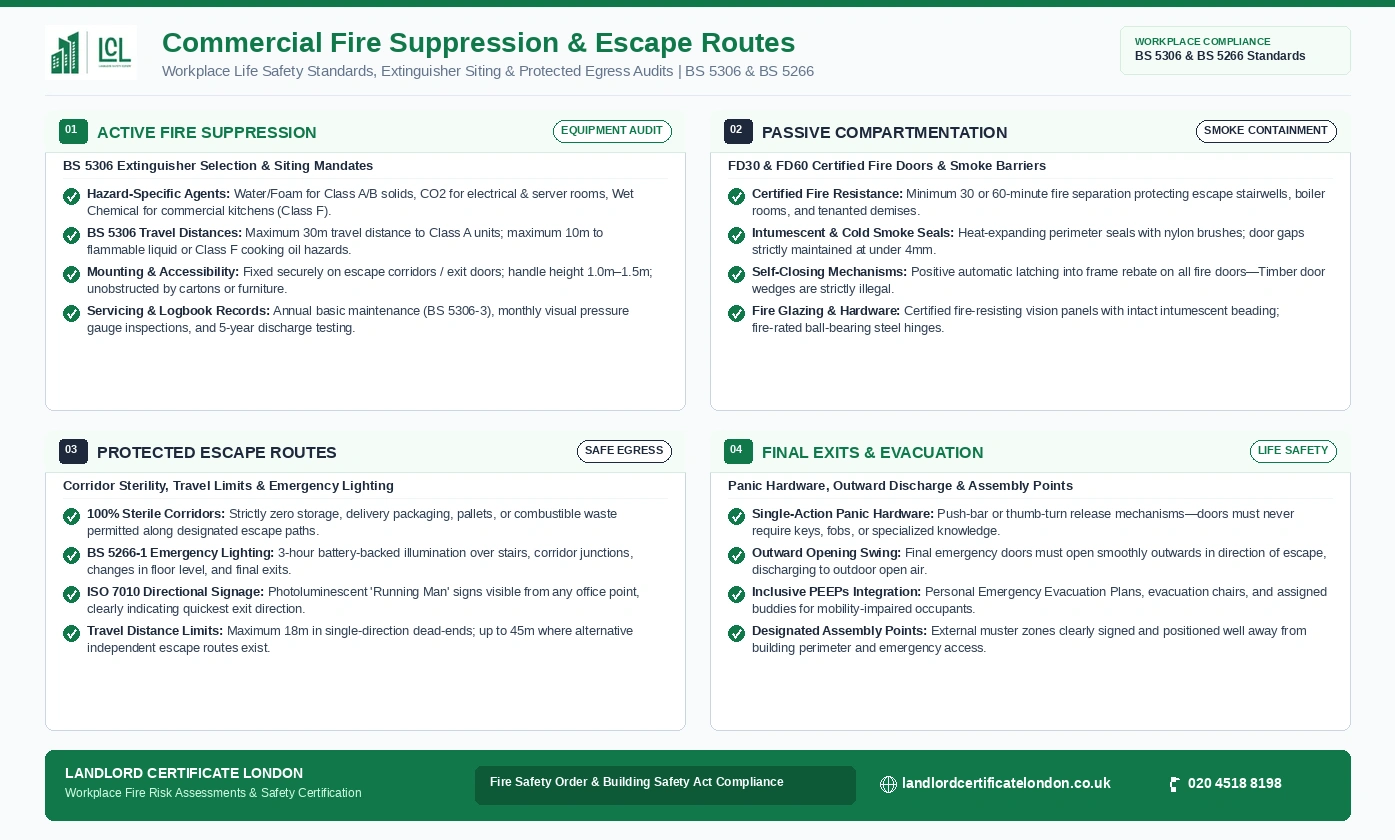
Workplace fire suppression and escape route compliance guide for London commercial premises under BS 5306, BS 5266, and UK fire safety legislation.
Fire Extinguisher Types & Testing Mandates (Water, Foam, CO2, Dry Powder, Wet Chemical)
Commercial workplaces need fire extinguishers selected according to their specific fire hazards and the suitability of each extinguishing agent. BS 5306-8 provides recommendations for selection and positioning, while BS 5306-3 covers commissioning and maintenance. Correct equipment selection reduces the risk of ineffective or dangerous firefighting attempts.
Commercial Fire Extinguisher Guide
Choose extinguishers according to workplace hazards, fire classes, and any electrical risks identified in your assessment. The guide below compares five common extinguisher types, their colour bands, suitable applications, and typical positions. It is a selection aid, not a substitute for competent advice or manufacturer instructions.
| Extinguisher Type | Colour Band | Fire Class / Risk | Typical Workplace Placement |
|---|---|---|---|
| Water | Red | Class A: wood, paper, textiles | Offices, retail premises, paper storage |
| Foam (AFFF) | Cream | Class A & B: combustible solids and flammable liquids | Warehouses, workshops, fuel storage areas |
| Carbon Dioxide (CO2) | Black | Class B; safe on live electrical equipment risks | Server rooms, distribution boards, offices |
| ABC Dry Powder | Blue | Class A, B, and C (flammable gases) | Selected industrial, forecourt, or outdoor locations |
| Wet Chemical | Yellow | Class F: deep fat fryers, cooking oils, and fats | Commercial kitchens, restaurant cooking lines |
Important: Electrical equipment is not a separate European fire class. Class D refers to combustible metals and requires specialist extinguishing agents, while standard water extinguishers must not be used on live electrical hazards unless specifically approved for that purpose. Select equipment using the assessed risks and manufacturer’s instructions.
Commercial Fire Extinguisher Testing and Servicing
Regular commercial fire extinguisher testing helps ensure equipment remains accessible, correctly positioned, and fit for use. Under BS 5306-3, portable extinguishers generally require an annual basic service by a competent technician. Additional servicing depends on extinguisher type, construction, condition, and manufacturer requirements.
Typical maintenance arrangements include:
- ✓Monthly: Routine visual checks for gauge pressure, physical damage, obstruction, missing safety pins, and unobstructed accessibility.
- ✓Annually: Basic maintenance inspection and certification service by a competent BAFE-registered technician.
- ✓Every five years: Extended servicing and discharge testing for water, foam, wet chemical, and powder models.
- ✓Every ten years: Full workshop overhaul, hydrostatic pressure testing, and valve replacement for CO2 cylinders.
Pricing by Building Scale: Up to 3 Floors (£249.99), 3-5 Floors (£369.99), 10-15 Floors (£589.99)
Commercial FRA pricing in London depends on building size, floor levels, layout complexity, occupancy, and operational hazards. Smaller premises usually require less inspection time, while larger multi-storey properties need more detailed evaluation. Landlord Certificate London provides building-based commercial assessment prices, alongside separately priced communal-area assessment options.
Commercial Fire Risk Assessment Pricing London
The listed commercial assessment packages use floor ranges to indicate pricing, while individual quotations may reflect occupancy, layouts, and specialist hazards. The separate communal-area service has a different starting price. Use this guide to compare the scope of your booking before confirming a fee or appointment.
| Property / Assessment Type | Building Scale | Listed Price |
|---|---|---|
| Communal-area assessment | Up to 3 floors | £149.99 |
| Commercial building assessment | Up to 3 floors | £249.99 |
| Commercial building assessment | 3–5 floors | £369.99 |
| Commercial building assessment | 10–15 floors | £589.99 |
These prices reflect the company’s published booking options and should be confirmed before payment. The £149.99 starting price applies to the specified communal-area option rather than every commercial building assessment. For buildings outside the listed ranges or with specialist hazards, request a quotation.
What Influences Fire Safety Certificate Cost in London?
Fire safety certificate cost in London depends on more than the number of floors. Assessors also consider occupant needs, hazardous work processes, alarm complexity, escape arrangements, and existing documentation. Review these factors before comparing quotes so you understand why different premises may need different inspection time and reporting.
- ✓Building size: Floor area, storeys, compartmentation design, and the number of separate rooms or tenancies.
- ✓Occupancy: Employee numbers, public footfall, and people requiring dedicated evacuation support (PEEPs).
- ✓Fire hazards: Commercial cooking, flammable materials, heavy machinery, or industrial warehouse processes.
- ✓System complexity: Multiple fire alarm zones, addressable panels, emergency lighting systems, and shared escape routes.
- ✓Documentation: Available architectural plans, previous assessments, and current testing maintenance records.
Commercial Fire Safety Certificate & Logbook Audit
A commercial fire safety logbook audit reviews records of inspections, maintenance, employee training, and emergency preparedness. It helps the Responsible Person identify overdue tests, unresolved equipment faults, and weaknesses in safety management. Maintaining accurate documentation supports inspections and demonstrates how your business manages ongoing fire risks.
Essential Fire Safety Log Book Checklist
Your fire safety log book should reflect the equipment installed and the requirements identified in your assessment. Keep records accessible to authorised personnel and update them after inspections or maintenance. Clear documentation also makes it easier to identify recurring faults and outstanding corrective actions.
Include the following records in your physical or digital logbook:
- ✓Fire alarm records: Weekly user manual call point tests, periodic servicing inspection certificates, and false alarm investigation reports.
- ✓Emergency lighting: Monthly functional flick tests, annual full three-hour duration discharge testing, and luminaire replacement records.
- ✓Extinguishers: Routine monthly pressure checks, annual basic servicing certification, and five-year extended maintenance.
- ✓Fire doors: Regular door gap, intumescent seal, vision panel, and self-closing mechanism inspection records.
- ✓Evacuation drill records: Evacuation drill dates, recorded clearance times, observed bottlenecks, and corrective actions taken.
- ✓Training records: New staff fire induction records, designated fire warden instruction certificates, and annual refresher sessions.
Workplace Fire Safety Certificate and Evacuation Drills
A workplace fire safety certificate or inspection report can support your documentation, but it does not automatically establish complete legal compliance. There is no universal government-issued certificate that replaces the duty to assess risks and implement necessary precautions. Your workplace must continue maintaining safe conditions after the assessment.
UK government guidance recommends at least one fire drill annually, with additional drills when the assessment indicates they are necessary. Record evacuation performance, identify difficulties, and improve procedures where needed. Fire warden numbers should reflect building risks, staff distribution, shift patterns, and evacuation arrangements rather than a fixed statutory ratio.
Maintaining Ongoing Commercial Fire Compliance
Review your commercial assessment regularly and after significant operational or structural changes. Changes in building layout, occupancy, equipment, or hazardous materials can affect previous findings. Although annual review is common practice, the Fire Safety Order does not impose one universal twelve-month expiry date.
For assistance with workplace compliance, contact Landlord Certificate London or use the commercial booking page. You can also discuss related commercial fire safety certification and maintenance services. Call 020 4518 8198 or email info@landlordcertificatelondon.co.uk.
Commercial Fire Safety FAQs
+ Is a written commercial fire risk assessment mandatory for small businesses?
Yes. Since 1 October 2023, Responsible Persons must record their fire risk assessments and safety arrangements regardless of employee numbers. Section 156 of the Building Safety Act 2022 amended the Regulatory Reform (Fire Safety) Order 2005, removing the previous five-employee documentation threshold.
+ How often must emergency lighting be tested in commercial buildings?
Emergency lighting normally requires monthly functional testing and annual full-duration testing in accordance with BS 5266-1 and the system’s design. A three-hour-rated system requires an appropriate three-hour duration test. Record failures, corrective actions, and completed servicing in your fire safety logbook.
+ What are the legal penalties for commercial fire safety non-compliance?
Serious breaches of the Regulatory Reform (Fire Safety) Order 2005 can result in enforcement notices, prohibition notices, prosecution, unlimited fines, and, for certain offences, imprisonment of up to two years. Actual penalties depend on the nature and circumstances of the offence.
+ How many fire marshals or fire wardens does a commercial office require?
There is no fixed statutory ratio that applies to every workplace. Some organisations use planning benchmarks of approximately one warden per 20–50 employees, but the appropriate number depends on occupancy, building layout, fire risks, shift patterns, and evacuation requirements.
+ How often do commercial fire extinguishers need servicing?
Portable extinguishers generally require annual basic servicing under BS 5306-3. Many water, foam, wet chemical, and powder extinguishers also require extended servicing at five-year intervals, while applicable CO2 extinguishers generally undergo a ten-year overhaul. Follow relevant standards and manufacturer instructions.
+ How much does a commercial fire risk assessment cost in London?
Landlord Certificate London’s published booking options list communal-area assessments from £149.99 for up to three floors. Commercial building assessments are listed at £249.99 for up to three floors, £369.99 for three to five floors, and £589.99 for ten to fifteen floors. Confirm your selected package before booking.
+ How long is a commercial fire risk assessment certificate valid for?
A fire risk assessment has no universal legal expiry date. The Responsible Person must review it regularly and whenever significant changes affect the premises, occupants, or fire risks. Annual reviews are a common management practice, although some workplaces require more frequent reviews.
About the Author: Hassan Sharif

Related Posts
Recent Posts
- Commercial Fire Risk Assessment London: Workplace Fire Compliance & Safety Certification
- Commercial Gas Safety Certificate CP42 London: Commercial Kitchen & Catering Compliance
- Landlord Gas Safety Certificate CP12 London: Annual Inspection & Legal Compliance Guide
- Commercial EICR London: Business Electrical Testing & Workplace Compliance Guide
- Residential EICR London: Complete Electrical Safety Inspection Guide for Landlords & Homeowners



Get Social