




To book EICR, property owners should first research qualified inspectors who adhere to regulatory standards. Documentation such as previous EICRs and electrical layouts should be gathered to facilitate the process. It is important to establish a timeline that minimizes disruption while ensuring the availability of qualified electricians. Clear communication regarding expectations and any specific concerns will enhance the booking process. Further insights into EICR’s importance and inspection processes can improve understanding of this critical assessment. For landlords requiring fast turnaround across Greater London, you can directly book an accredited EICR certificate inspection with registered professionals.
How to Book an EICR Certificate in the UK: Step-by-Step Direct Booking Protocol
To book an EICR (Electrical Installation Condition Report) efficiently in the UK, landlords and property managers must follow a four-step statutory compliance pathway under the Electrical Safety Standards in the Private Rented Sector (England) Regulations 2020:
- Identify Circuit Count & Property Scope: Count the number of consumer units (fuse boxes) and active outgoing electrical circuits. Standard domestic quotes generally cover up to 10 or 12 circuits per board; older London properties with split boards or sub-panels require prior confirmation to avoid unexpected on-site surcharges.
- Verify Competence & Registration: Book exclusively through electricians holding City & Guilds 2391 (or 2394/2395) inspection and testing credentials, registered with accredited regulatory bodies such as NICEIC, NAPIT, or the Electrical Contractors’ Association (ECA).
- Coordinate Safe Power Isolation (45–60 Minutes): Establish a clear appointment window with your tenants. While visual inspection occurs under live supply, statutory dead testing (insulation resistance and continuity) requires the electrical mains to be completely shut off for 45 to 60 minutes per distribution board.
- Obtain the Completed Digital Report Within 28 Days: Following testing, receive your official BS 7671 condition report detailing circuit test sheets, overall outcome (Satisfactory or Unsatisfactory), and any coded observations (C1, C2, C3, FI). You must provide this copy to existing tenants within 28 days and incoming tenants before occupancy.
Key Takeaways
- Research qualified electricians to ensure they are certified for EICR compliance before booking your inspection.
- Gather relevant documentation, including previous EICRs and electrical layouts, to facilitate the assessment process.
- Establish a timeline for scheduling the EICR to minimize disruptions to your daily operations.
- Communicate specific expectations and areas of concern clearly with the chosen electrician for accurate evaluations.
- Keep previous EICRs accessible for reference and ensure all communications with the service provider are clear.
What Is an Electrical Installation Condition Report (EICR)?
An Electrical Installation Condition Report (EICR) serves as a thorough assessment of the safety and performance of electrical installations within a property.

This document evaluates compliance with current regulations and identifies potential hazards, thereby ensuring electrical safety. The importance cannot be overstated; it aids in proactive maintenance and risk mitigation, safeguarding occupants from electrical failures.
The EICR process encompasses visual inspections, testing of fixed wiring, and analysis of circuit performance, culminating in a detailed report outlining necessary remedial actions.
Ultimately, an EICR is essential for maintaining high standards of electrical safety and legal compliance in any property.
Why Is an EICR Necessary for Property Owners?
Property owners must recognize the critical importance of obtaining an Electrical Installation Condition Report (EICR) to guarantee the safety and reliability of their electrical systems.
An EICR provides essential insights into the condition of electrical installations, identifying potential hazards and deficiencies that could compromise property safety.
The benefits of an EICR extend beyond immediate safety; they include enhanced property value, reduced liability risks, and compliance with industry standards.

Field Insight from Hassan Sharif
Business Development Manager & Compliance Specialist at Landlord Certificate London
“When landlords ring our dispatch desk across London to book an EICR, the most expensive mistake they make is booking solely on headline price without checking circuit capacity or remedial policies. In Victorian conversions across boroughs like Hackney, Islington, or Wandsworth, an owner books a ‘standard 2-bedroom inspection,’ but our engineer arrives to find an unlabelled 16-way consumer unit, DIY extension wiring, and non-RCD protected circuits hidden behind tiled kitchens. If you book through anonymous third-party lead generation apps, an outsourced sub-contractor will often mark code C2 on minor technicalities just to inflate remedial quotes, or refuse to issue a Minor Electrical Installation Works Certificate (MEIWC) when another sparky fixes the fault. Booking directly with an established London compliance partner ensures you receive calibrated dead-testing, honest observation coding under BS 7671:2018+A4:2026, and guaranteed council-accepted documentation without tenant friction.”
Legal Requirements for EICR Inspections
The legal framework governing Electrical Installation Condition Reports (EICR) outlines specific regulations that mandate their execution in various contexts.
Compliance with these regulations necessitates adherence to stipulated frequencies for inspections, which are critical for ensuring electrical safety.
Understanding these legal requirements is essential for property owners and managers to mitigate risks associated with electrical hazards.
EICR Regulations Overview
While compliance with EICR regulations is essential for guaranteeing electrical safety, these legal requirements establish clear guidelines for inspections across various property types.
Understanding these regulations is critical for property owners and managers to achieve EICR compliance standards effectively.
- Guarantees adherence to safety protocols
- Protects tenants and property from electrical hazards
- Facilitates insurance claims and legal defenses
- Enhances property value through documented inspections
Frequency of Inspections
Regular inspections of electrical installations are mandated by law to guarantee ongoing safety and compliance with EICR standards.
The frequency of these inspections is determined by specific inspection intervals, which can vary based on the type of property and its usage. Generally, domestic properties require an EICR every five years, while commercial establishments may necessitate more frequent evaluations under a dedicated Commercial EICR inspection regime.
A thorough risk assessment is essential in establishing these intervals, as it identifies potential hazards and informs the necessary frequency of checks.
Adhering to these legal requirements ensures that electrical systems remain safe, reliable, and in line with current regulations.
EICR Booking Models Compared: Direct Specialist vs. Lead Generator vs. Sole Electrician
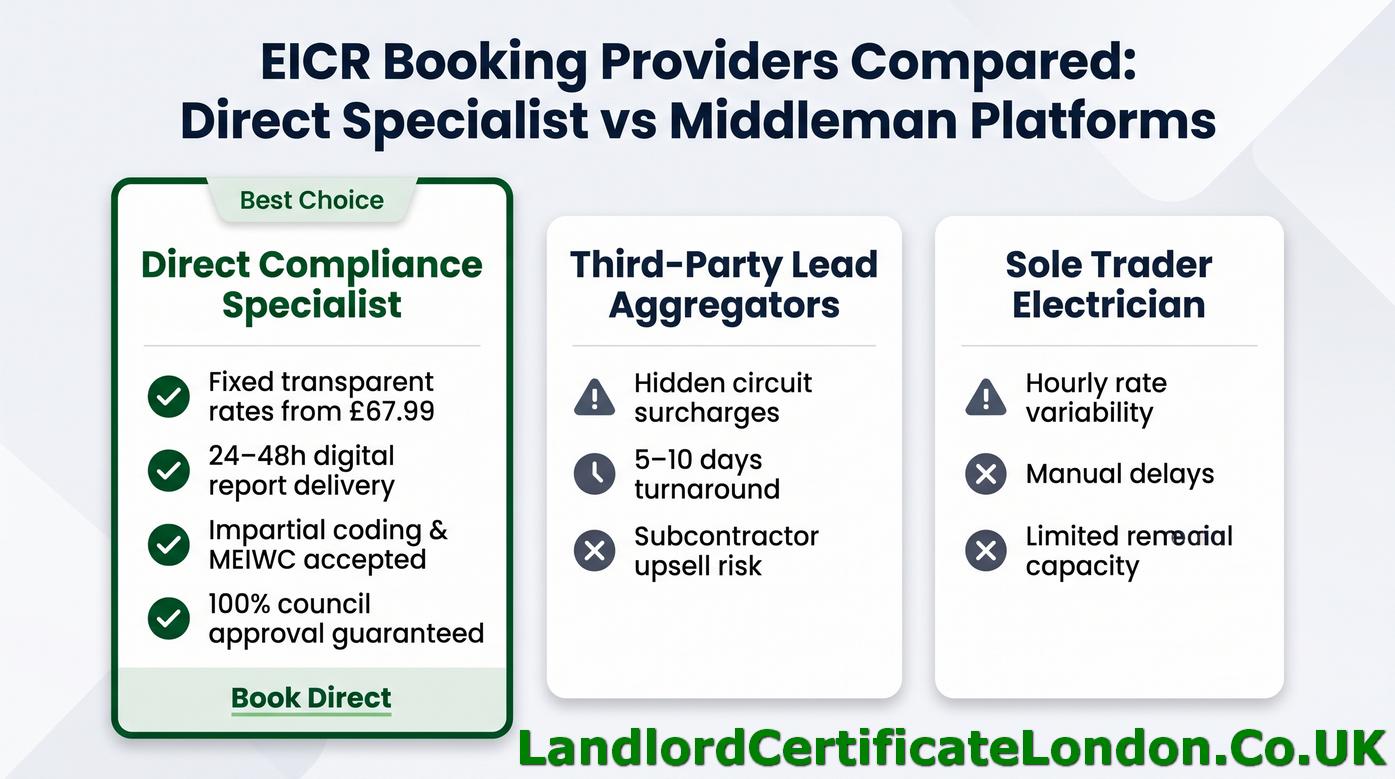
Comparison of UK EICR booking models: direct compliance specialist vs third-party lead aggregators and sole traders.
Property owners evaluating where to book their electrical inspection face three distinct service delivery models across the UK. Understanding the operational differences between booking a dedicated compliance provider versus generic middleman networks is critical for cost protection and council compliance:
| Operational Metric | Direct Compliance Specialist (e.g., LCL) | Third-Party Lead Aggregators | Individual Sole Trader |
|---|---|---|---|
| Pricing Transparency | Fixed upfront pricing from £67.99 by bedroom/circuit count. | Artificially low teaser rates (£40–£50) with hidden circuit surcharges. | Hourly rates or estimates; high variability between visits. |
| Report Turnaround Time | Digital certificate issued within 24 to 48 hours of testing. | 5 to 10 working days; dependent on subcontractor upload. | 3 to 7 days, often delayed by ongoing manual site work. |
| Remedial Works Conflict | Impartial observation coding; accepts 3rd-party MEIWC fixes. | High risk; sub-contractors incentivized to fail boards for costly repairs. | May push internal rewires or lack capacity for urgent 28-day remedials. |
| Local Council Acceptance | 100% guaranteed acceptance across all 32 London Boroughs. | Variable; risk of unverified inspector credentials. | Accepted if registered with NICEIC/NAPIT/ECA scheme. |
The EICR Inspection Process Explained
The EICR inspection process involves several critical stages, beginning with thorough preparation to guarantee that all necessary information and tools are available.
Following this, the inspection procedure encompasses systematic testing and assessment of electrical installations to identify potential hazards.
Finally, the findings are compiled into a report that includes recommendations for remedial actions based on the observed conditions.
Preparation for EICR
Preparation for an Electrical Installation Condition Report (EICR) involves a systematic approach to confirm that all elements of the electrical installation are thoroughly evaluated.
A detailed preparation checklist is essential to guarantee nothing is overlooked, and the inspection timeframe is adhered to efficiently.
- Verify that all electrical documentation is available.
- Conduct a preliminary visual inspection of installations.
- Identify and rectify any immediate safety hazards.
- Schedule the EICR at a time that minimizes disruption.
This meticulous preparation lays the foundation for a successful EICR, confirming compliance with regulatory standards and enhancing overall electrical safety.
Inspection Procedure Overview
Following the meticulous groundwork laid in preparation, the inspection procedure for an Electrical Installation Condition Report (EICR) involves a thorough assessment of the electrical system’s integrity and safety.
Adhering to established inspection standards, qualified professionals employ various testing methods to evaluate critical components such as wiring, circuit breakers, and protective devices.
Visual inspections complement testing, guaranteeing all aspects meet regulatory compliance. The process meticulously identifies potential hazards, such as overloads or deterioration, thereby establishing a detailed understanding of the installation’s condition.
This systematic approach guarantees that the electrical system operates safely and efficiently, safeguarding both property and personnel.
Reporting and Recommendations
A thorough EICR report encapsulates the findings of the inspection, detailing the condition of the electrical installation and identifying any deficiencies or hazards.
Adhering to established reporting standards, the report should also provide clear recommendation strategies for necessary remedial actions.
- Identification of immediate safety concerns
- Recommendations for compliance with current regulations
- Prioritization of repairs based on severity
- Guidance on maintenance practices to prevent future issues
This structured approach guarantees that stakeholders understand the implications of the findings and can effectively address any identified risks, thereby enhancing the overall safety and integrity of the electrical system.
Common Issues Identified in EICR Assessments
While conducting an Electrical Installation Condition Report (EICR) assessment, several common issues frequently arise, highlighting potential hazards and compliance failures within electrical systems.
Typical findings include common electrical faults such as inadequate earthing, undersized conductors, and aging insulation. These deficiencies often lead to safety compliance issues, posing risks like electric shock or fire hazards.
Moreover, improper labeling of circuits and non-compliance with local regulations are frequently noted, indicating a lack of due diligence in maintenance.
Addressing these issues is critical for ensuring both the safety of occupants and the integrity of the electrical installation, facilitating long-term operational reliability.
How to Choose a Qualified EICR Inspector
How can one guarantee the selection of a qualified EICR inspector? Ensuring the competency of an inspector necessitates a thorough evaluation of their credentials and experience.
Key factors to take into account include:
- Verified EICR qualifications and certifications
- Demonstrated inspector experience in diverse electrical installations
- Positive client testimonials and references
- Compliance with the latest electrical safety regulationseicr stan
How Often Should You Book an EICR?
The frequency of booking an Electrical Installation Condition Report (EICR) is influenced by several factors, including the type of property, usage, and the age of the electrical installation. Regular assessments guarantee compliance with safety standards, thereby underscoring the importance.
| Property Type | Recommended Interval | EICR Costs (Live Fixed Pricing) |
|---|---|---|
| Studio Bedroom Flat | Every 5 years (or change of tenancy) | £67.99 |
| 1 – 3 Bedroom Property | Every 5 years (statutory PRS regulations) | £94.99 |
| 4 Bedroom Property | Every 5 years | £104.99 |
| 5 Bedroom Property | Every 5 years | £139.99 |
| 6 Bedroom Property | Every 5 years | £159.99 |
| Commercial Premises | Every 5 years | £149.99 |
| Industrial Facilities | Every 3 years (or annually) | £300 – £800 |
These intervals reflect best practices for electrical safety management across London and the UK.
Steps to Book Your EICR Efficiently
To guarantee a smooth booking process for an Electrical Installation Condition Report (EICR), property owners should follow a structured approach that prioritizes organization and clarity.
Implementing effective booking tips facilitates efficient scheduling and enhances overall outcomes. Key steps include:
- Research qualified electricians to ascertain compliance with regulations.
- Gather relevant documentation such as previous EICRs and electrical layouts.
- Establish a clear timeline for scheduling inspections to minimize disruptions.
- Communicate expectations clearly with the chosen service provider to guarantee alignment on report requirements. Booking directly through an established compliance team like Landlord Certificate London gives you direct access to accredited testing engineers, fixed circuit pricing, and priority slots.
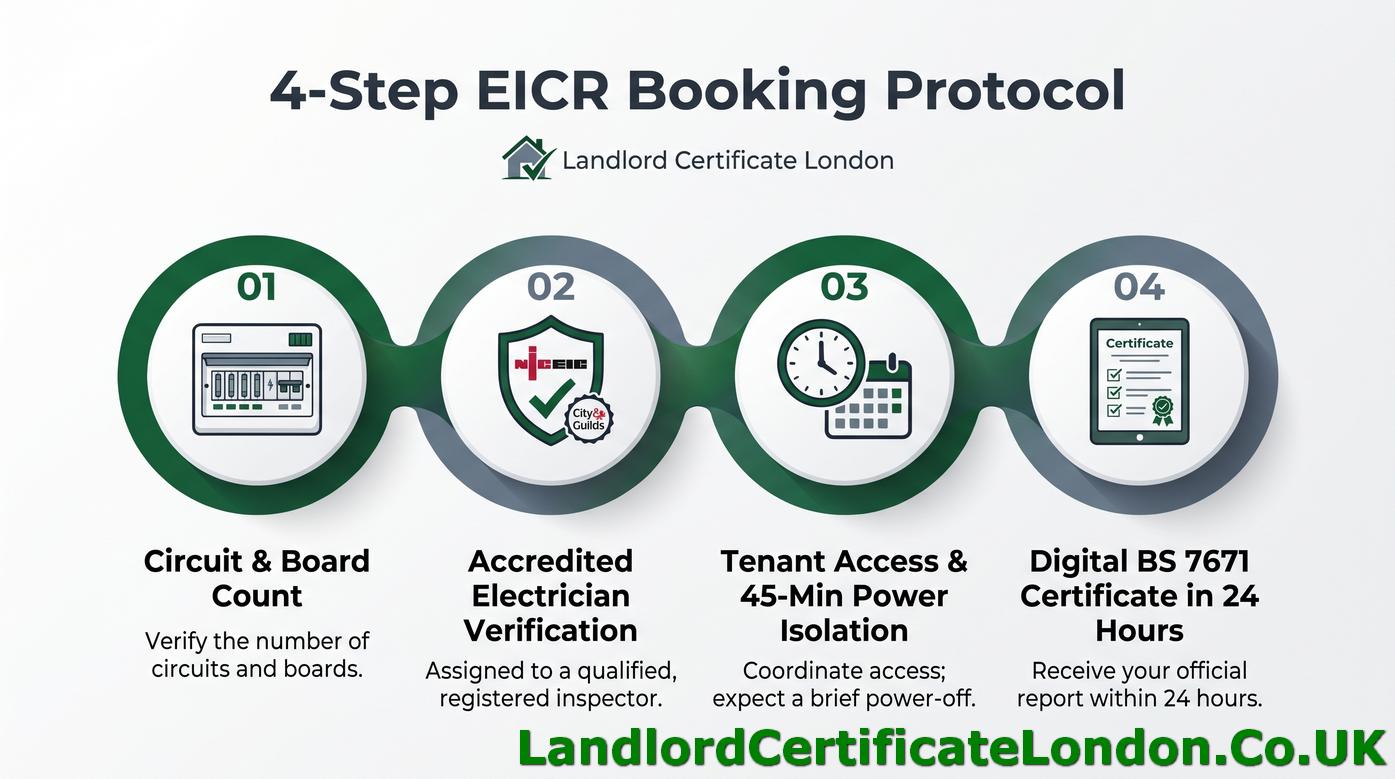
Step-by-step guide on how to book an EICR certificate efficiently for UK residential and commercial properties.
Frequently Asked Questions About Booking an EICR
+ How long in advance should I book an EICR?
For rental properties with tenancies renewing, it is strongly advised to book your EICR 2 to 3 weeks before your existing certificate expires. This allows sufficient time to coordinate tenant access and gives you a comfortable window to arrange any C1, C2, or FI remedial repairs within the statutory 28-day repair window without facing council enforcement action.
+ What information do I need to provide when booking an EICR?
When scheduling an inspection, provide the exact property address, the number of bedrooms, the location of the main consumer unit (fuse box), and the total number of usable circuits. Mentioning any secondary sub-boards, recent extensions, outbuildings, or EV chargers upfront ensures an accurate quotation and prevents delays on the testing day.
+ Does the power need to be turned off during the EICR inspection?
Yes. While visual inspections are conducted with the power on, statutory dead testing (insulation resistance, conductor continuity, and polarity) requires power isolation for approximately 45 to 60 minutes per distribution board. Occupants should save computer work and keep high-draw appliances unplugged during this window.
+ What happens if my property receives an Unsatisfactory EICR?
If the inspection flags Code C1 (Danger Present), Code C2 (Potentially Dangerous), or FI (Further Investigation Required), the outcome is Unsatisfactory. Landlords have a legal deadline of 28 days (or sooner if specified) to complete remedial repairs. Once rectified by a registered electrician, you receive a Minor Works Certificate (MEIWC) which, together with the original EICR, establishes full statutory compliance without needing a complete re-test.
About the Author: Hassan Sharif

Related Posts

Get Social
Recent Posts
- Commercial Gas Safety Certificate CP42 London: Commercial Kitchen & Catering Compliance
- Landlord Gas Safety Certificate CP12 London: Annual Inspection & Legal Compliance Guide
- Commercial EICR London: Business Electrical Testing & Workplace Compliance Guide
- Residential EICR London: Complete Electrical Safety Inspection Guide for Landlords & Homeowners
- Property Owners and Landlords Across London