




In commercial building management across London, keeping fire safety compliant is never a box-ticking exercise. Under the Regulatory Reform (Fire Safety) Order 2005, the Responsible Person must ensure that core life-safety measures—fire alarms, exit signage, emergency lighting, fire extinguishers, and automatic sprinkler systems—work together as a reliable defence. Each element plays a distinct part in detecting a blaze early, guiding occupants out safely, and protecting the structure before London Fire Brigade crews arrive.
Simply having equipment mounted on the wall is rarely enough. Real-world effectiveness depends on proper BS-compliant installation, routine servicing, and staff who know how to act without hesitation under pressure. Below, we examine the five essential fire safety elements every commercial landlord, facility manager, and business owner should keep under regular review.

Field Insight from Hassan Sharif
Business Development Manager & Compliance Specialist at Landlord Certificate London
“When we walk through commercial units across Central and East London—whether a multi-floor office in Holborn, a busy restaurant kitchen in Shoreditch, or a retail parade with flats above—the weakest link is almost never a missing alarm panel; it’s neglected coordination between systems. We regularly find emergency bulkhead lights whose backup batteries fail well short of a full three-hour drain test, or fire exit signs partially obscured by newly fitted stock shelving. Keeping your weekly call-point checks, annual extinguisher servicing, and lighting logs up to date turns compliance from a last-minute scramble into everyday peace of mind.”
1. Commercial Fire Alarms & Early Detection Systems
A properly specified commercial fire alarm system is the first line of defence in any workplace or mixed-use premises. Installed and maintained in line with BS 5839-1, smoke, heat, and multi-sensor detectors provide crucial early warning so occupants can evacuate before smoke or flame blocks escape routes.
To deliver reliable protection, fire detection must be integrated with your wider life-safety infrastructure—linking seamlessly with emergency lighting, magnetic fire-door retainers, and, where fitted, automatic sprinkler valves.

Acting as the central nervous system of building safety, the control panel monitors call points and detectors continuously, triggering audible sounders and visual beacons during an incident. When paired with London Fire Brigade workplace guidance, weekly call-point tests and six-monthly engineer servicing ensure faults are spotted long before an emergency occurs.
- ✓Test a different manual call point every week and record results in the fire logbook.
- ✓Schedule competent BS 5839-1 engineer servicing at least every six months.
- ✓Keep zone charts beside the main panel current whenever office partitions change.
2. Illuminated Fire Exit Signs & Wayfinding
Building on early alarm activation, clear fire exit signage guides staff, visitors, and customers along unfamiliar corridors towards the nearest final exit. Under UK safety sign regulations (BS EN ISO 7010), signs must use recognised green-and-white running-person pictograms, remain unobstructed at all times, and stay legible even if mains power fails.
Well-positioned signage dramatically reduces hesitation and bottlenecks during an evacuation—especially in deep-plan offices, basement venues, or multi-tenant commercial buildings where visitors may not know secondary stairwells.
| Evacuation Scenario | Without Compliant Exit Signs | With Compliant Exit Signs |
|---|---|---|
| Smoke-filled corridors | High confusion, wrong turns, and panic | Clear, guided, and orderly egress |
| Mains power failure | Darkened stairwells and potential chaos | Continuous illuminated direction |
| High occupancy & visitors | Bottlenecks at main reception doors | Balanced, systematic evacuation |
| Out-of-hours emergencies | Heightened disorientation for lone workers | Immediate visual assurance to safety |
3. Emergency Lighting Along Escape Routes
Emergency lighting maintains safe visibility across corridors, stairwells, changes of floor level, and fire-fighting equipment points whenever normal lighting fails. Under UK standard BS 5266-1, non-maintained or maintained emergency luminaires must switch on automatically upon a local circuit failure and illuminate escape routes reliably.

In UK commercial premises, emergency lighting systems are typically required to provide at least three hours (180 minutes) of backup illumination—giving occupants ample time to evacuate and allowing fire crews to navigate safely inside. Monthly short functional flick-tests and an annual full three-hour discharge test confirm batteries and LEDs will hold up when needed.
- ✓Monthly flick-test: Briefly simulate mains failure via test key to confirm every unit illuminates.
- ✓Annual 3-hour duration test: Verify full battery autonomy and replace weak units promptly.
- ✓Critical coverage points: Illuminate external final-exit doors, stair treads, call points, and extinguishers.
4. Portable Fire Extinguishers & Staff Readiness
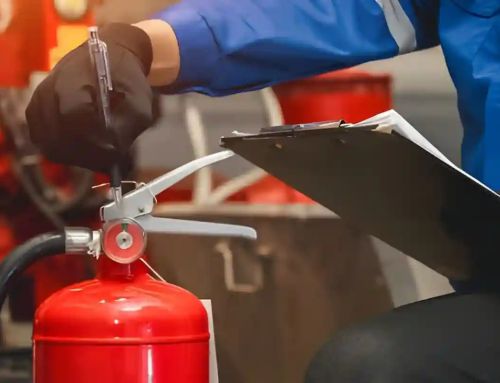
Portable fire extinguishers allow trained staff to tackle a small, contained fire safely—or clear a blocked exit path—before it escalates. Under BS 5306-8, extinguisher selection, capacity, and wall-mounting locations must reflect both floor area and the specific hazards present in each zone of the building.

Matching the right extinguishing agent to the fuel source prevents dangerous mistakes—such as using water on live electrical equipment or hot cooking oil. Following HSE fire safety toolbox guidance, UK workplaces rely on colour-coded extinguishers covering Class A (wood, paper, textiles), Class B (flammable liquids), Class C (flammable gases), Class D (combustible metals), CO₂ for live electrical risks, and Class F wet-chemical units for commercial kitchen fryers.
Extinguishers require monthly visual checks by staff (confirming pressure gauges sit in the green zone and safety pins remain intact) alongside annual servicing to BS 5306-3 by a competent technician. Equally important, nominated fire wardens should receive hands-on training so they know when to fight a small fire and when to evacuate immediately.
5. Automatic Fire Sprinklers & Active Suppression
Automatic fire sprinkler systems provide round-the-clock active suppression across larger commercial buildings, warehouses, high-rise blocks, and hospitality venues. Unlike portable extinguishers, sprinklers operate autonomously: individual glass-bulb heads activate only when heat reaches a preset temperature threshold directly above the fire, containing flames before structural flashover can occur.
In the UK, commercial sprinkler installations are designed and maintained to standards such as BS EN 12845, governing sprinkler head spacing, hydraulic water supply, and flow-switch integration with the building’s fire alarm panel. When linked to Building Management Systems (BMS), activation can also trigger smoke-control dampers and recall lifts to the ground floor safely.
- ✓Maintain a clear 500mm gap beneath every sprinkler head when stacking stock or racking.
- ✓Carry out weekly pump and alarm-valve checks alongside scheduled BS EN 12845 servicing.
- ✓Never paint over sprinkler bulbs or conceal heads during interior fit-outs.
Frequently Asked Questions
+ How often should commercial fire safety equipment maintenance be scheduled?
Routine checks follow UK British Standards: fire alarm call points are tested weekly with six-monthly engineer servicing (BS 5839-1), emergency lighting undergoes monthly flick-tests and an annual three-hour drain test (BS 5266-1), and portable extinguishers are visually checked monthly with annual servicing (BS 5306-3).
+ Are there specific fire safety protocols for high-rise commercial buildings?
Yes. High-rise commercial premises require enhanced detection, protected escape stairwells, dry or wet rising mains for fire crews, emergency voice communication systems in refuge areas, and regular reviews of the building’s Fire Risk Assessment.
+ What training do employees need in fire emergency procedures?
Staff should receive fire safety induction training upon joining and periodic refresher drills covering alarm recognition, escape routes, assembly points, and how to raise the alarm. Nominated fire marshals also need practical extinguisher and sweep-check training.
+ How does building layout affect fire safety measures?
Internal layout dictates maximum travel distances to exits, where fire doors and compartment walls sit, and how many detectors, luminaires, and exit signs are required. Whenever partitions are moved during an office fit-out, the Fire Risk Assessment and alarm zoning must be updated.
+ What are the legal consequences of non-compliance with UK fire safety rules?
Failure to comply with the Regulatory Reform (Fire Safety) Order 2005 can lead to formal Enforcement or Prohibition Notices from the Fire and Rescue Authority, unlimited fines, invalidation of commercial buildings insurance, and—in severe cases—criminal prosecution.
Bringing All Five Elements Together
Fire alarms, illuminated exit signs, three-hour emergency lighting, properly matched fire extinguishers, and automatic sprinkler systems work best as one coordinated strategy. Keeping inspection logs current, training staff regularly, and booking competent servicing protects both your occupants and your commercial property across London. To arrange your commercial fire safety inspection or compliance check, book online with Landlord Certificate London or call 020 4518 8198.
About the Author: Hassan Sharif

Related Posts
Get Social
Recent Posts
- Asbestos Management Surveys for London Rental Properties: CAR 2012 Landlord Guide
- Commercial Fire Risk Assessment London: Workplace Fire Compliance & Safety Certification
- Commercial Gas Safety Certificate CP42 London: Commercial Kitchen & Catering Compliance
- Landlord Gas Safety Certificate CP12 London: Annual Inspection & Legal Compliance Guide
- Commercial EICR London: Business Electrical Testing & Workplace Compliance Guide