



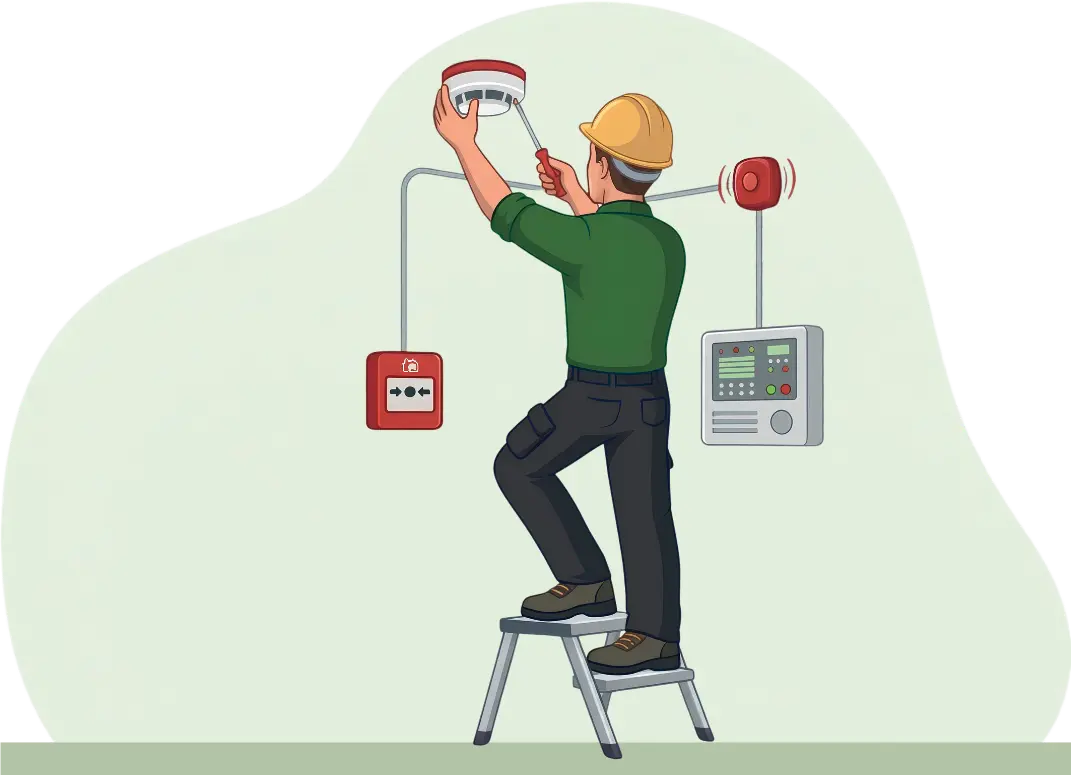
fire alarm installation

Fire Alarm Panel Installation London

A new panel, sized to your property and wired in properly, tested zone by zone, and certified the same day. For landlords, HMOs, homeowners and small commercial units across London.

  • 10+ years installing across London
  • BAFE SP203-1 Registered
  • NICEIC/NAPIT Registered
  • BS 5839 Compliant
  • Same-day certificate

Fire Alarm Installation

£209.99*

* Per Alarm
* All inclusive (No hidden cost)
* Includes labour and materials
* All wiring to be done in surface mounted trunking

Fire Alarm Installation as per Standards

The installation of fire alarms in the United Kingdom is governed by BS5389. The term “BS” stands for British Standards, while 5389 refers to the number of the relevant standard that covers fire safety equipment. In order to give an alarm before smoke becomes dense enough to react with the flame on an open fire, a smoke detector meeting this certification is a device that detects smoke via the heat of smoke particles or any specially designed smoke -specific indicator.

Fire alarm installation in accordance with BS5389 standards involves installing smoke detectors according to specifications for spacing and height, as well as electrical wiring requirements for smoke detectors and battery backup.

*£5Parking charges are applicable in case of paid parking.
*£18 Congestion Charge applicable in case the property is in congestion charge zone

Client Testimonials

Excellent

Trustpilot rating
Rated 4.5 out of 5 based on 185 reviews
Trustpilot Trustpilot

Want to know the cost?

Get a fixed quote for your property

  • No hidden costs
  • Quote before you book anything

*£5 Parking charges are applicable in case of paid parking.
*£18 Congestion Charge applicable in case the property is in congestion charge zone

What a fire alarm panel actually does

The panel is the brain of a panel-based fire alarm system. Smoke detectors, heat detectors, manual call points and sounders connect back to the control equipment, allowing the system to indicate an alarm condition, identify the affected zone or device, and monitor faults.

Where a panel-based system is required, the control panel provides a central point for alarm indication, fault monitoring and system control. For larger HMOs, offices, converted buildings and other properties where a panel is specified, the system can be divided into zones or designed as an addressable system so the location of an activation can be identified more easily.

However, not every property requires a separate control panel. Many domestic properties and some HMOs may instead use interconnected Grade D1 or Grade D2 mains-powered smoke and heat alarms without a separate panel.

Do You Want To Book Multiple Services?

EICR

Gas Safety

Fire Safety

Who needs this

Landlords & HMO owners

Your local authority or HMO licence conditions may specify the grade and category of fire alarm system required for your property.

Depending on the property, this may require a Grade A panel-based fire alarm system.

Homeowners

Renovating, converting a loft, adding an extension or carrying out major building work? The fire alarm arrangement required will depend on the property layout, Building Control requirements and the type of work being carried out. This may involve mains-powered interlinked alarms or, where required, a panel-based system.

Commercial premises

Shops, offices and other commercial premises may require a panel-based fire alarm system depending on the building, occupancy, fire risk assessment and applicable fire safety requirements.

Where required, the system can cover escape routes and higher-risk areas such as kitchens, plant rooms and other identified risk areas.

Property managers

If a panel is flagging faults, won’t hold its standby supply, has become unreliable or is simply past its working life, we can assess the existing installation and replace the panel where appropriate.

Existing detectors and other components may be retained where they are compatible, serviceable and suitable for the new panel.

What’s included

  • Site visit to check your existing wiring, detector count and property layout
  • Supply and installation of a panel sized correctly for the required number of zones or devices
  • Wiring in of new or compatible existing smoke and heat detectors
  • Manual call points and sounders where required
  • Full testing of relevant zones, devices, sounders and call points
  • Testing of mains and standby power supplies
  • Fault checks and commissioning before handover
  • Installation or commissioning certification/documentation following successful completion

How We Work

Our process is designed to keep things simple:

1. You get in touch

Tell us roughly how many detectors you’ve got, or plan to have, what type of property it is, how many floors there are, and whether you already have an existing fire alarm system. If you have HMO licence conditions or a fire risk assessment, you can also send these to us.We’ll then give you an initial indication of the likely scope and cost.

2. We book a visit

Where necessary, an engineer comes out, checks the property, confirms detector numbers, existing wiring, equipment compatibility and the panel or system requirements, and answers any questions on site.

3. We install and wire the panel

The panel is mounted in a suitable and accessible location based on the system design and property layout.

We then install or connect the required compatible detection, alarm and control equipment.

4. We test everything

The system is tested before handover, including relevant detectors, call points, sounders, zones or device identification, fault monitoring, backup power and mains supply.

5. You get your certificate

After successful installation, testing, and commissioning, we provide relevant installation documentation for the work completed. Where the installation & commissioning are completed, certification can be issued.

Fire Alarm Panel Installation London

How much does this cost?

Pricing depends on how many smoke and heat detectors your system needs to cover, the number of zones or devices required, whether you need a conventional or addressable system, and whether it’s a wired or wireless installation.

Existing cabling, equipment compatibility and the size and layout of the property can also affect the price.

Panel types we install

Conventional

A conventional fire alarm system divides the property into zones. If a detector or call point triggers, the panel identifies the affected zone rather than necessarily identifying the exact individual detector. It’s a practical and cost-effective panel option for many smaller buildings where a panel-based system is required and individual device identification isn’t necessary.

Addressable

With an addressable system, compatible individual devices have their own identity or address within the system. Instead of simply showing something like “Zone 3”, the panel can provide more precise information about the detector or device that has activated. Addressable systems can be better suited to larger HMOs, blocks of flats and commercial buildings where locating an activation or fault more precisely is useful.

Wireless

Wireless fire alarm systems use radio communication between compatible devices and control equipment, reducing the amount of new cabling required. They’re useful where running new wiring isn’t practical or would cause significant disruption, including listed buildings, occupied HMOs, refurbished properties or buildings with limited access to wall and ceiling voids.

Wireless and addressable are not the same thing. Wireless describes how compatible equipment communicates, while addressable refers to the system’s ability to identify individual devices.

Grade A fire alarm systems, explained

If you’ve been told your property needs a Grade A fire alarm system, this is what that actually means and why it may matter when licensing or managing an HMO.

Fire detection and alarm systems in domestic premises, including HMOs, are covered by BS 5839-6.

A Grade A fire alarm system is built around dedicated control and indicating equipment and normally includes compatible detectors, warning devices and a standby power supply so the system can continue operating during a mains failure.

The system can be divided into zones or, depending on the equipment and design, use addressable devices.

Grade A systems are commonly specified for larger, more complex or higher-risk HMOs and other domestic properties where a panel-based system is required.

However, a property should not automatically be treated as requiring Grade A simply because it is an HMO. The correct grade depends on the property and the applicable licensing, fire risk and fire safety requirements.

Grade A Fire Alarm Systems vs Other Alarm Types

Grade A fire alarm systems use dedicated control panels with central monitoring, fault indication, zoning and standby power. They are designed for buildings where a panel-based fire detection system is required, including larger HMOs, complex residential buildings and commercial premises.

Grade A, Grade D1, Grade D2 and HMO licensing

Fire alarm requirements for HMOs vary according to the property type, number of storeys, layout, occupancy, fire risk and the requirements of the relevant London borough.

Depending on the property, the required fire alarm arrangement may be:

  • Grade A panel-based system
  • LD1 / LD2 detector coverage
  • Other specified fire alarm requirements

There is no single fire alarm grade that automatically applies to every HMO.

If you’re not sure what your licence requires, the safest way to check is your HMO licence conditions, local authority guidance or fire risk assessment.

If your documents specify a Grade A system, that’s exactly the type of panel-based installation we can quote for, including the panel, compatible detection equipment, zoning or addressing where required, testing and commissioning.

If your fire alarm requirements specify another system type, we can advise on the appropriate solution.

Why book with us

Landlord Certificate London has been carrying out property safety inspections and installation work across London for over ten years. Our team works with landlords, HMO owners, homeowners, managing agents and commercial clients across London and the M25.

  • Fixed pricing before we book anything in, so there are no unexpected costs after the work
  • Conventional, addressable and wireless systems
  • Installation, testing and commissioning
  • Certification/documentation following successful completion
  • Engineers covering London and the M25 corridor
  • Book online or call us and we’ll arrange the job over the phone

Frequently Asked Questions

Not every property requires a separate fire alarm control panel.

Some houses, flats and HMOs can use interconnected Grade D1 or Grade D2 mains-powered smoke and heat alarms.

Larger, more complex or higher-risk properties may require a Grade A panel-based system.

The correct arrangement should be based on the property, its use and any applicable HMO licence, fire risk assessment, Building Control or fire safety requirements.

Installation time depends on the size and complexity of the property and the type of system being installed.

A smaller installation may be completed during one visit. Larger properties with more zones or devices, or installations requiring new cabling, can take longer. We’ll give you a realistic indication once we understand the property and scope of work.

Potentially, yes.

Existing detectors and other equipment can only be retained where they are compatible with the new panel, in suitable condition and appropriate for the system being installed.

We’ll check this during the assessment and let you know what can be retained and what needs replacing.

Yes. Following successful installation, testing and commissioning, we provide the relevant installation or commissioning documentation for the work completed.

Where the installation and commissioning are completed during the same visit, certification can normally be issued following completion.

Yes.

Wired systems are commonly used where a panel-based installation is required, but we can also install suitable wireless systems where running new cabling would be difficult or disruptive, such as listed buildings, occupied properties or refurbished buildings.

We install fire alarm panels and fire alarm systems across London and out to the M25, including Enfield, Barnet, Haringey, Islington, Camden, Westminster, Hammersmith & Fulham, Wandsworth, Croydon and Greenwich.

Contact us if you’re unsure whether your property falls within our coverage area.

Book your fire alarm panel installation

Need a new fire alarm panel, Grade A system or an upgrade to your existing installation?

Get in touch and tell us about your property. If you already have HMO licence conditions, a fire risk assessment or photographs of your existing system, send them to us and we’ll quote based on the actual requirements.

Client Testimonials

Excellent

Trustpilot rating
Rated 4.5 out of 5 based on 185 reviews
Trustpilot Trustpilot

*Labour and Materials are all included in Fire Alarm Installation

*All wiring to be done in surface mounted trunking

*£5 Parking Charges are applicable in case of paid parking.

*£18 Congestion Charge applicable in case the property is in congestion charge zone

Fire Alarm Installation

£209.99*

* Per Alarm

* All inclusive (No hidden cost)

* Includes labour and materials

* All wiring to be done in surface mounted trunking